
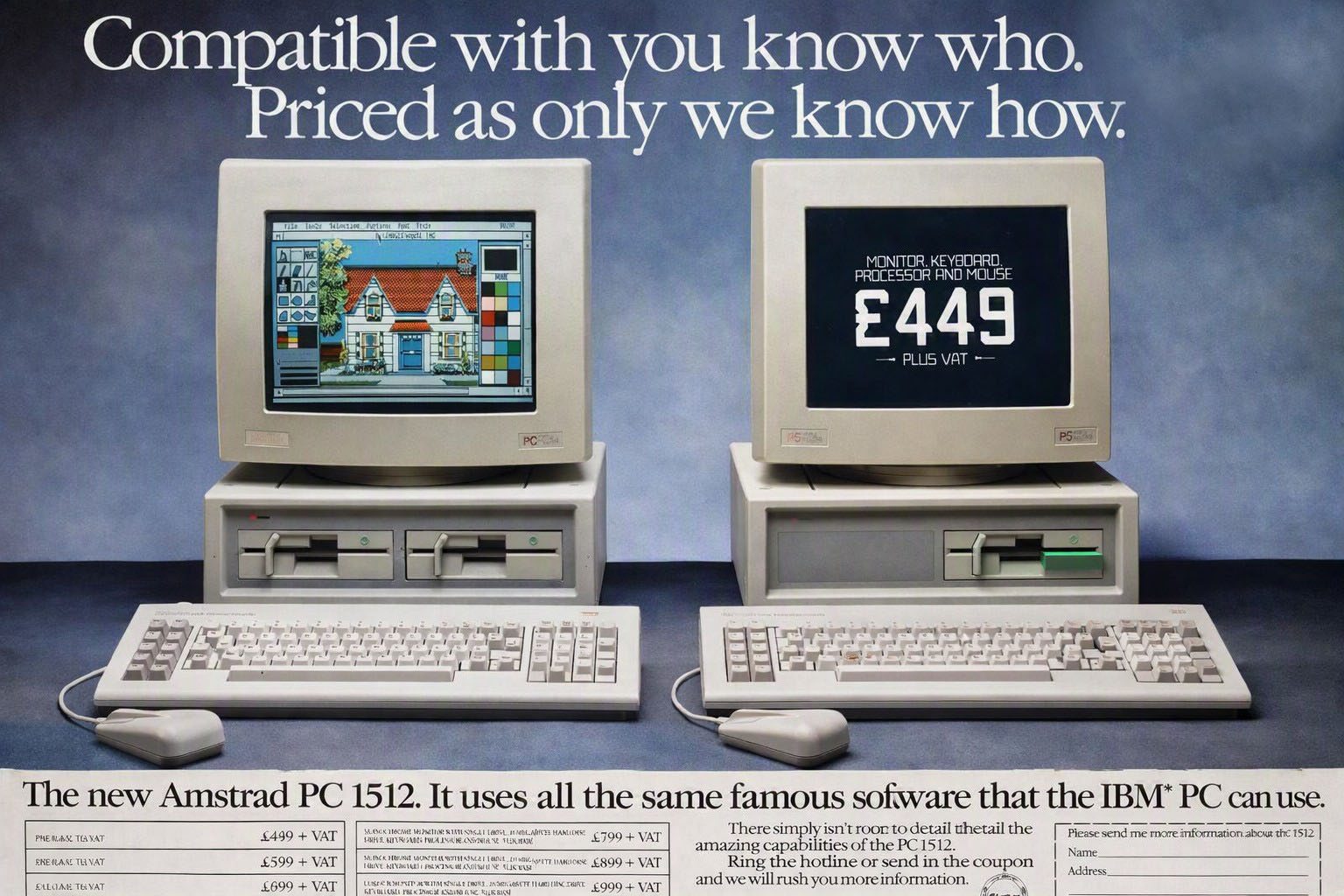
When I upgraded from my Amstrad PCW to the Amstrad PC1512 in the 1980s, I knew I was stepping up to a “proper” PC — but nothing prepared me for how different the experience would feel. The PCW had served me well, but it was a word processor first and a computer second. No mouse. No graphical interface. Everything was keyboard‑driven, menu‑based, and very functional.
So when I sat down with the PC1512 and loaded GEM, Digital Research’s graphical environment, it felt like I’d jumped into an entirely new era of computing. The Amstrad has a custom CGA graphics at 640 x 200, but with 16 colours as opposed to 2. Eventually, not many programs took advantage, but the Gem system did.
Leaving the PCW behind
The PCW was brilliant for writing and basic tasks, but it was limited. Its screen, its software, its workflow — everything was designed around word processing. I’d grown used to navigating menus with the keyboard, selecting options with shortcuts, and working in a very structured, text‑based environment.
There was no mouse. No windows. No icons. No graphical workspace.
So even though I’d read about GEM and knew what it was, actually using it on the PC1512 was a shock — in a good way.
Seeing GEM for the first time on the PC1512

The moment GEM loaded, the PC1512 felt alive. A mouse pointer. Clickable icons. A proper desktop. It was the first time I’d ever controlled a computer visually instead of through keyboard commands.
It wasn’t bundled with the full suite, so I bought the GEM applications myself — and each one opened up a new world that the PCW simply couldn’t touch.
1st Word — familiar purpose, completely different experience

I’d used word processors on the PCW, but 1st Word on the PC1512 was a completely different experience. Instead of navigating menus with the keyboard, I could click through options. Formatting felt natural. Editing felt fluid. Saving and loading documents didn’t require memorising shortcuts.
It wasn’t just an upgrade — it was a new way of working.
GEM Draw — my first encounter with real graphics

The PCW had no graphics environment. So when I bought GEM Draw, it was genuinely mind‑blowing.
Vector graphics were something I’d only ever seen in magazines or on expensive business machines. Suddenly I was drawing smooth lines, perfect circles, and scalable shapes on my own PC.
I spent hours experimenting, not because I needed to, but because it was fascinating. It felt like the computer had unlocked a creative side I didn’t know it had.
GEM Paint — creativity the PCW never offered

The PCW couldn’t do anything like GEM Paint. Buying it for the PC1512 opened up a completely new world.
Brushes, fills, patterns, colours — it was simple, but it was fun. It made the PC feel like a creative tool rather than just a productivity machine. After coming from the PCW’s very business‑focused environment, this felt refreshing and exciting.
Why GEM felt so revolutionary to me
Because I came from the PCW — a machine with no mouse, no GUI, and no graphics — GEM wasn’t just an upgrade. It was a transformation.
GEM gave me:
- A proper graphical desktop
- A mouse‑driven interface
- Vector and raster graphics
- Applications that felt modern and intuitive
- A sense that the PC1512 was capable of far more than I expected
It made the PC1512 feel like a completely different class of machine.
The Apple lawsuit — something I only learned about years later
At the time, I had no idea Apple had sued Digital Research over GEM looking too much like the Macintosh. I just used the software and enjoyed it. Only years later did I learn that overlapping windows and other features had been removed.
Even with those limitations, GEM still felt miles ahead of early Windows.
Looking back — why GEM still matters to me
GEM didn’t win the GUI war, but it left a lasting impression on me. It powered the Atari ST, it became the foundation of Ventura Publisher, and it introduced thousands of people to graphical computing.
But for me, its importance is personal.
GEM was the moment I moved from the PCW’s text‑based world into true graphical computing. It made my first “proper” PC feel modern, creative, and genuinely exciting. It was the system that showed me what a computer could really do.
Even now, decades later, I still remember that upgrade — not just as a new machine, but as a complete shift in how I interacted with technology.