
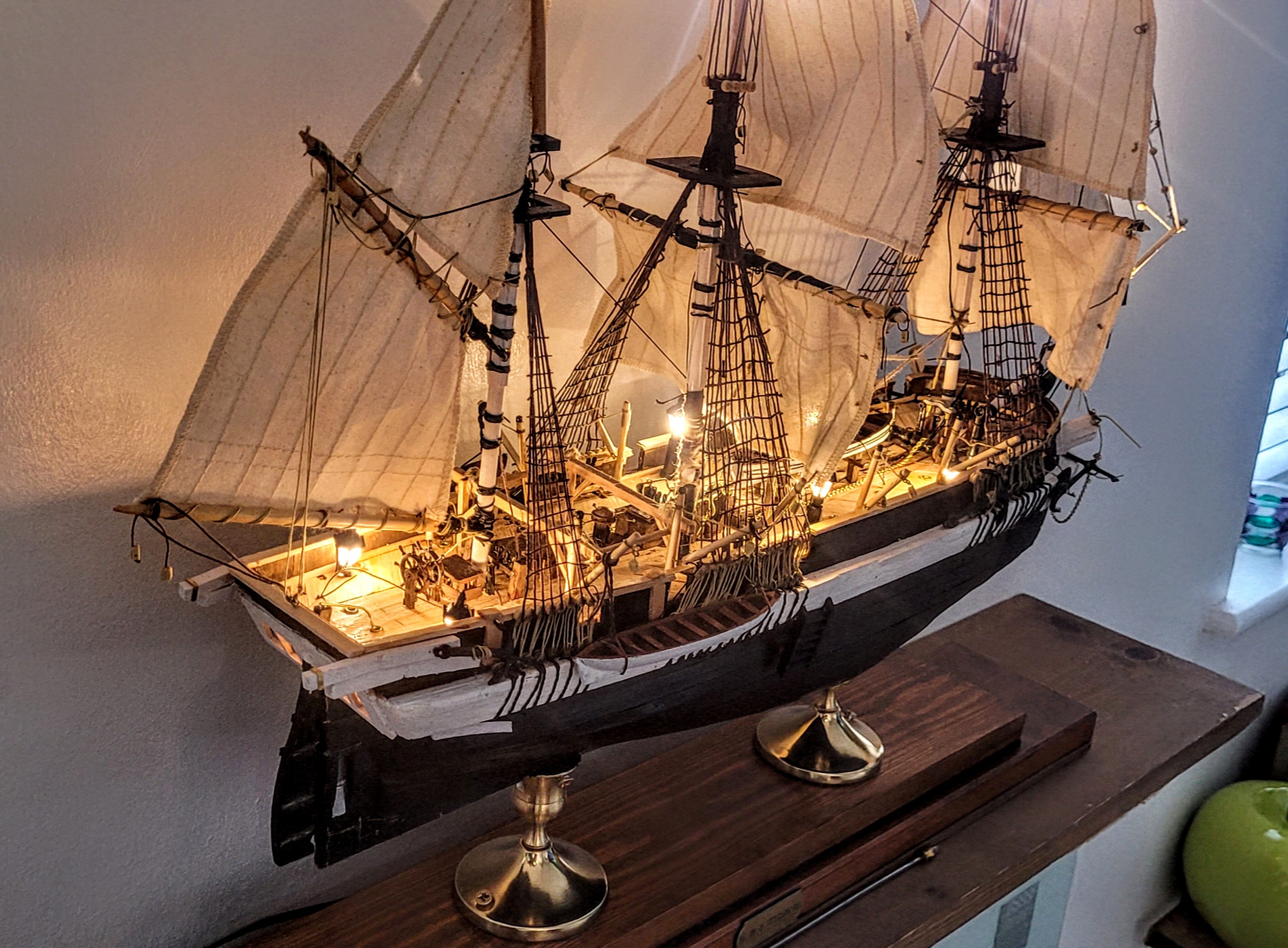
Delighted to have completed the HMS Terror wood model by Occre, the same manufacturers as the RMS Titanic model done previously.
Ironically, this was less pages as per the instruction guide, but far more intricate work. To be perfectly honest, I cut a lot of corners during the stringing. I didn’t have the patience to thread the holes, etc. therefore most were glued. Visually it looks fine, so I didn’t have huge regrets. Other shortcut was the metal icebreaker parts. I don’t have a workshop, so didn’t really have tools to complete this. Therefore, I used a different texture tape and simulated them.
Unlike the original, this was fully lighted, using period (mid-1800s) period lighting.


HMS Terror was a Royal Navy bomb vessel launched in 1813 that later became one of the most famous exploration ships of the 19th century, remembered for its role in both the War of 1812 and the ill‑fated Franklin Expedition.
HMS Terror was built at Topsham, Devon, as part of the Vesuvius‑class bomb vessels, designed with reinforced hulls to withstand the recoil of heavy mortars. Initially, she served in the War of 1812, taking part in the bombardment of Fort McHenry during the Battle of Baltimore in September 1814—an event that inspired Francis Scott Key to write “The Star‑Spangled Banner.” Terror also fought in other engagements along the American coast, including the bombardment of Stonington, Connecticut, and raids in Georgia.
By the 1830s, her military role had ended, and she was refitted for exploration. In 1836, under George Back, Terror sailed into the Arctic but suffered severe damage from pack ice in the aptly named Frozen Strait. Remarkably, she was repaired and later joined HMS Erebus for James Clark Ross’s Antarctic expedition (1839–1843). Together, the ships circumnavigated Antarctica, charted the Ross Ice Shelf, and made significant contributions to polar science.
Her final voyage began in 1845, when Sir John Franklin commanded both Terror and Erebus in a bid to discover the Northwest Passage. The expedition was well‑equipped, with steam engines and reinforced hulls, but it ended in tragedy. The ships became trapped in ice near King William Island, and all 129 crew members perished. For decades, the fate of the expedition was a mystery, with only scattered relics and Inuit testimony hinting at starvation, disease, and desperate attempts to trek overland. The wreck of HMS Erebus was found in 2014, and HMS Terror followed in 2016, discovered in Terror Bay, Nunavut, astonishingly well‑preserved beneath the Arctic waters.
Today, HMS Terror is remembered not only as a warship but as a vessel that bridged the transition from naval combat to scientific exploration. Its story embodies both the ambition and peril of Britain’s 19th‑century quest to dominate global trade routes and expand scientific knowledge.


Her final voyage began in 1845, when Sir John Franklin commanded both Terror and Erebus in a bid to discover the Northwest Passage. The expedition was well‑equipped, with steam engines and reinforced hulls, but it ended in tragedy. The ships became trapped in ice near King William Island, and all 129 crew members perished. For decades, the fate of the expedition was a mystery, with only scattered relics and Inuit testimony hinting at starvation, disease, and desperate attempts to trek overland. The wreck of HMS Erebus was found in 2014, and HMS Terror followed in 2016, discovered in Terror Bay, Nunavut, astonishingly well‑preserved beneath the Arctic waters.
Today, HMS Terror is remembered not only as a warship but as a vessel that bridged the transition from naval combat to scientific exploration. Its story embodies both the ambition and peril of Britain’s 19th‑century quest to dominate global trade routes and expand scientific knowledge.
The final years of HMS Terror’s service are inseparable from the tragedy of the Franklin Expedition. In 1845, Terror and her sister ship Erebus set out under Sir John Franklin to chart the Northwest Passage. Both vessels had been refitted with steam engines and reinforced hulls to withstand Arctic ice, and they carried provisions intended to last three years. Despite this preparation, the ships became trapped in pack ice near King William Island by 1846. Franklin himself died in 1847, leaving command to Francis Crozier of Terror.
From that point, the expedition descended into desperation. Inuit testimony and later archaeological evidence suggest that the crews attempted to abandon the ships in 1848, hauling sledges laden with supplies across the ice. Starvation, scurvy, and lead poisoning from poorly tinned food compounded their suffering. Skeletons and artifacts found along the escape routes indicate that small groups tried to reach safety but none survived. For decades, the fate of Terror and Erebus remained a mystery, fueling speculation and search expeditions. The discovery of Erebus in 2014 and Terror in 2016 finally confirmed their resting places, with Terror astonishingly well‑preserved in Terror Bay, Nunavut. These wrecks provide a haunting glimpse into the expedition’s last years, marking the end of an ambitious but doomed chapter in Britain’s Arctic exploration.